
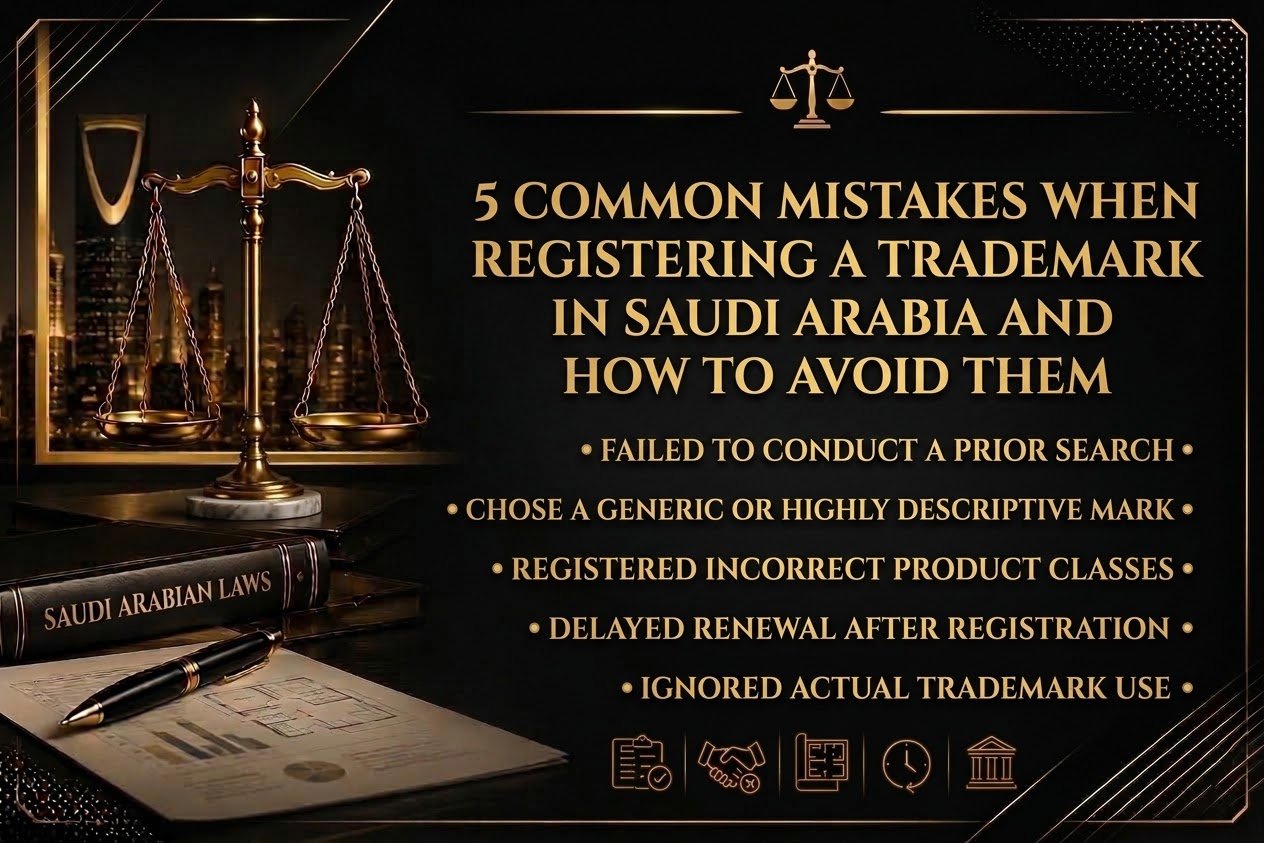
5 Common Mistakes When Registering a Trademark in Saudi Arabia and How to Avoid Them
A trademark is one of the most important assets of a business. It is not limited to the name or logo that distinguishes a business; over time, it can become a valuable intellectual property asset with significant commercial value.
Trademark registration grants its owner exclusive rights related to the use, licensing, and disposition of the trademark, in accordance with the applicable laws and regulations.
As commercial activities and startups continue to expand in the Kingdom of Saudi Arabia, registering and protecting a trademark has become an important step that should be handled carefully. Certain mistakes made before submitting an application or during the registration process may result in the application being rejected or may delay obtaining protection.
Below are 5 common mistakes when registering a trademark in Saudi Arabia, along with practical ways to avoid them.
1. Failing to Search for Similar Trademarks Before Registration
One of the most common mistakes is choosing a name or logo for a business and immediately proceeding with the registration process without first conducting a search for registered trademarks or pending applications that may be similar.
The existence of a similar trademark in the same field or in a related class may lead to complications during the examination of the trademark application.
The Saudi Authority for Intellectual Property (SAIP) provides a self-search service for registered trademarks, making this an important step before beginning the registration process.
The search should not be limited to exact matches. It is also important to consider similarities in:
- Words and expressions.
- Pronunciation.
- Visual elements and design.
- The nature of the goods or services.
- Related goods or services and classes.
How Can You Avoid This Mistake?
It is advisable to conduct a thorough preliminary search for the trademark before adopting it commercially or spending significant amounts on branding and marketing.
Early research can also help identify potential conflicts at an early stage, before incurring additional costs to redesign or rebuild the brand identity.
2. Choosing a Trademark That Lacks Distinctiveness
Not every name or description qualifies as a protectable trademark.
The grounds for refusing registration include cases where a trademark lacks distinctiveness, consists of information or descriptions commonly used to identify the relevant goods or services, as well as other circumstances established by the applicable laws and standards.
Therefore, choosing a very generic name or a direct description of a product or service may affect the ability to register the trademark or the scope of protection available to it.
Illustrative Example
If a business offers a particular product, choosing a word that directly describes the product may present greater registration challenges than choosing a distinctive mark that helps distinguish the business’s goods or services from those of others.
How Can You Avoid This Mistake?
The legal protectability of the trademark should be considered from the name-selection stage, rather than after the business identity has already been developed.
It is advisable to assess the trademark from a legal perspective before investing significant amounts in marketing, packaging, advertising, and other branding activities.
3. Registering the Trademark in the Wrong Class
Trademark registration does not necessarily mean that a name or logo is protected absolutely across all types of business activities.
A trademark is associated with the goods or services specified under the relevant classes. Therefore, selecting the appropriate class and accurately describing the goods and services are important steps in the registration process.
An inaccurate classification may result in a scope of protection that does not adequately correspond to the business’s actual activities or future plans.
Accordingly, the business owner should identify:
- The nature of the current business activity.
- The goods or services offered by the business.
- Products or services the business plans to launch in the future.
- The classes associated with these activities.
- Whether additional trademark registrations may be necessary where the nature of the business activity differs.
How Can You Avoid This Mistake?
The appropriate class should not be selected simply because its name appears to be the closest match to the business activity. Instead, the actual nature of the products and services and the scope of the trademark’s intended use should be carefully assessed.
Future business expansion should also be taken into consideration when determining the appropriate scope of protection.
4. Assuming That a Trade Name Protects the Trademark
Another common mistake among business owners is confusing a trade name with a trademark.
A trademark is used to distinguish goods or services, whereas a trade name identifies the business in its commercial dealings and is regulated under the applicable laws.
Accordingly, registering a business name or using it commercially does not automatically mean that the name is protected as a trademark within the scope of trademark protection.
If the name or logo represents a business identity that is used on products, services, or in marketing, it is important to consider registering it separately as a trademark where appropriate.
How Can You Avoid This Mistake?
It is important to distinguish between:
Trade Name:
Identifies the business in its commercial dealings.
Trademark:
Used to distinguish goods or services from those of others.
A business may need to protect each of them through the appropriate legal process, depending on the nature of their use.
5. Failing to Follow Up on the Application After Submission
Submitting a trademark application is not the end of the process.
According to the Saudi Authority for Intellectual Property’s trademark registration service, the application is examined and may be accepted, accepted subject to amendment, or rejected.
Where an amendment is required, a specified period is provided to complete the required action.
Following acceptance, the application enters the publication stage. SAIP states that the publication period is 60 days. If no opposition is filed during this period, the registration process proceeds, including payment of the final fees for issuing the registration certificate.
Therefore, failing to monitor the application or ignoring notifications and deadlines may result in losing the opportunity to complete the registration process within the required timeframe.
How Can You Avoid This Mistake?
Make sure to:
- Regularly monitor the status of the application.
- Review notifications issued in relation to the application.
- Respond to requests for amendments within the specified deadlines.
- Follow up during the publication stage.
- Comply with deadlines relating to payments and completion of the registration procedures.
How Can You Avoid Trademark Registration Mistakes in Saudi Arabia?
Before submitting a trademark registration application, a business owner can take several practical steps:
- Choose a distinctive and protectable trademark.
- Conduct a preliminary search for similar trademarks.
- Accurately identify the relevant goods, services, and classes.
- Understand the distinction between a trade name and a trademark.
- Review the application details and supporting documents before submission.
- Monitor the application after submission and respond to any comments or requirements.
- Pay close attention to deadlines relating to amendments, publication, and fees.
- Keep records and evidence relating to ownership and use of the trademark.
The Saudi Authority for Intellectual Property provides an electronic trademark registration service for individuals and businesses. The process includes examination, acceptance, publication, and issuance of the registration certificate, subject to the applicable requirements.
What Should You Do If Your Trademark Registration Application Is Rejected?
The rejection of a trademark registration application does not necessarily mean that all available options have come to an end.
According to the Saudi Authority for Intellectual Property’s guidance, in cases where the applicable law permits, an applicant may challenge or appeal a decision refusing trademark registration in accordance with the applicable procedures and deadlines. Such an objection or appeal may be reviewed by the competent Appeals Committee.
It is therefore important to determine the reason for the rejection first, and then assess whether the relevant issues can be addressed or whether an appeal is available under the applicable legal procedures.
The available procedures may vary depending on the reason for rejection, the stage of the application, and the specific circumstances of the case.
Trademark Protection Begins Before Registration
Errors in selecting the name or class, or failure to conduct a preliminary search, may result in additional time and costs, particularly if the business has already begun developing its brand identity and marketing its products under the trademark.
Therefore, intellectual property protection does not begin only when the registration certificate is issued. It begins with selecting the trademark, assessing its registrability, determining the appropriate scope of protection, and then properly following the registration process and maintaining the rights associated with the trademark.
Given the importance of trademarks to businesses and startups, reviewing the legal status of a trademark before filing an application may help identify potential issues at an early stage.
Conclusion
Trademark registration in Saudi Arabia is an important step toward protecting a business’s brand identity. However, successful registration does not depend solely on submitting an application.
It is important to pay attention to several matters before and during the registration process, including:
- Choosing a distinctive trademark.
- Conducting a preliminary search for similar trademarks.
- Selecting the appropriate classes.
- Distinguishing between a trade name and a trademark.
- Reviewing the application details and supporting documents.
- Monitoring the application and applicable deadlines.
- Properly addressing any comments, objections, or decisions in accordance with the applicable procedures.
If you are considering registering a trademark or protecting your business’s intellectual property rights, obtaining specialized legal advice may be beneficial to assess the trademark and determine the appropriate procedures based on the specific circumstances of your case.
Suleiman Al-Omari Law Firm
Suleiman Al-Omari Law Firm provides specialized services in the field of intellectual property and trademarks through lawyers and legal and Sharia consultants, assisting business owners and entrepreneurs in assessing their rights and taking appropriate legal steps in accordance with the laws applicable in the Kingdom of Saudi Arabia.
📞 Contact Us for Consultations
+966 53 777 8130
You can contact us via WhatsApp by [clicking here].
Legal Disclaimer: This article is for informational and educational purposes only and does not constitute legal advice for any specific case. Procedures, rights, and obligations vary depending on the facts of each case, the type of procedure, and the laws and regulations in force. Accordingly, consulting a qualified legal professional is recommended where necessary.